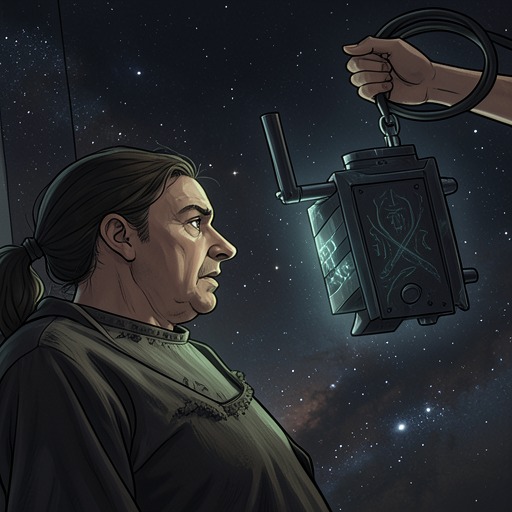
Death Ray
The Old AxolotlThe Death Ray is the name given to the force believed to have caused the Extermination, an event whose apparent precision and speed left survivors with more evidence of its effects than of its mechanism. First understood through breaking news and imperfect scientific analogies, it later becomes the subject of an archival investigation: the surviving traces point toward a remote, apparently empty region of space, while leaving open whether a weapon existed there at all. The Ray is therefore both a catastrophe and an unresolved problem of knowledge. Its consequences are unmistakable; its source, composition, and purpose remain uncertain.
First Reports and the Limits of the Neutron-Bomb Explanation
The first public indication is a red headline on gazeta.pl predicting that a neutron wave will hit Warsaw at 19:54. The site soon crashes and is replaced by an error message. Bartek and those around him have no settled explanation: the wider world is searching online, and Wikipedia has also failed. The early account of the Death Ray thus arrives through a communications system that cannot sustain the demand for information. The event is not initially presented as a known weapon whose operation can simply be looked up, but as a disaster forcing people to assemble an explanation from whatever scattered material remains accessible.
A lay explanation of a neutron bomb seems, for a moment, to fit. Such a weapon would kill through fast neutrons while leaving buildings and equipment intact. But the comparison breaks down on timing. The expected delay between radiation exposure and death would be measured in dozens of hours, whereas reports from Asian cities describe people dying almost immediately. The difference is crucial: the recognizable effects suggest one category of weapon, but the speed of the deaths contradicts its ordinary account. The Death Ray is consequently identified by analogy, then made more mysterious by the very detail that appears to define it.
The Ray’s Reach and the Surviving Record
A later legend about the solar aircraft Dawntreader XII supplies a view of the world after the Ray has passed, while also showing how little direct confirmation remains. The aircraft’s crew flee ahead of the Death Meridian, staying above the eightieth parallel because the plane cannot match the Earth’s rotation at the equator. After their second circuit, they are flying over a world stripped of organic life. Their radio calls receive answers only from automatic airport and military systems; they make no contact with transformers and do not go online.
The Ray is said to have lasted 177 hours. The aircraft’s crew can infer that it has ended only from machine-transmitted information coming from the other hemisphere. Their disagreement over whether to land leads some, after two weeks, to put down near an ice settlement in northern Greenland, gather food and water, and leave those unwilling to continue before taking off again. The legend ends with the claim that the aircraft is still circling above the transoceanic heights. Its details give the Ray duration, geographic reach, and an aftermath in which machines continue to communicate after organic life has disappeared. Yet the passage is explicitly framed as a legend, not as a verified instrument record; its vivid survival account cannot settle the weapon’s physical explanation.
Reconstructing an Origin in Empty Space
Much later, investigators turn from stories of survival to the remains of the record itself. They gather archives from the Extermination, fragmentary data, old robot registers, and estimates of the neutron wave’s timing precise to the nanosecond. Combining these traces, they calculate a point on the horizon and a distance. The resulting direction is 17.6 light-years from the Sun, in Ophiuchus, just beyond Barnard’s Star, and more than two light-years from the nearest system.
The apparent destination offers no visible source. It is described as gravitationally blank, exerting no influence on the motion of matter, emitting nothing, and concealing no radiation from outer space. This absence supports one practical hypothesis: whoever fired the Ray could have built a generator in an anonymous region of space, then destroyed it after use, preventing a later search from finding its remains. The investigators compare the logic to firing from outside the reach of retaliation rather than from one’s own home. That account makes the empty location intelligible as concealment, but it remains an inference rather than a discovered machine. It also leaves the central question of motive unanswered.
Competing Explanations and Unknown Composition
The proposed destroyed-generator explanation is described as the fastest and easiest answer, not a complete one. A broader possibility is that there was no machine at the calculated location and no generator for the Death Ray. The investigation therefore does not simply progress from ignorance to a solved origin: its evidence narrows the direction of inquiry while expanding the range of possible explanations. The calculated point may indicate where a weapon was placed, or it may be a misleadingly concrete answer to a phenomenon produced by something else.
The beam’s composition is similarly unsettled. Investigators say they cannot know exactly what kind of radiation was involved because the necessary sensors were not calibrated for the Extermination. Their reconstruction depends on indirect traces and on measurements that survived by chance. Rapid neutrons are treated as one component, but not necessarily the only one: the proposed account includes other particles attuned to a frequency capable of breaking DNA bonds. This qualification matters because the original neutron-bomb analogy cannot explain either the speed or the full scale of the destruction. What survives is evidence for a complex beam, not a complete specification of its operation.
Scale, Purpose, and the Question of Extermination
The inquiry’s most expansive hypothesis links the Ray to a wormhole and to a civilization able to act across the observable and non-observable universe. If the beam came through such a route, the investigators reason, its makers would have access to knowledge of possible trajectories of life and technology. That reasoning leads toward the Gardener of the Universe hypothesis. It is a chain of conditional implications, not a confirmed account: the evidence has not demonstrated a wormhole, identified a civilization, or established that anyone possessed such a universal database.
The hypothesis also sharpens the question of purpose. Bartek observes that a civilization capable of such reach could have destroyed Earth outright, for example by sending it into a black hole. The fact that the Ray instead appears to have acted with extraordinary specificity encourages the possibility that its intended result was not simply extermination. The suggestion that its makers did not kill humanity is a speculative interpretation of the method, not a fact proved by the surviving data. The Death Ray’s defining tension remains between an outcome that looks like total destruction of organic life and an operation whose apparent selectivity may imply another aim. Its empty point of origin, uncertain physics, and unresolved motive keep the catastrophe legible as an effect while denying its survivors a final explanation.